Most Mesocycles Can Start at Four to Eight Weeks
The best length is long enough to repeat the important lifts, make planned progressions, and observe more than day-to-day noise. It is also short enough that you can review the plan before an unsuitable exercise, excessive workload, or unrealistic target consumes months. That tradeoff is why four, six, and eight weeks are useful planning choices even though none is a biological deadline.
Block length organizes the work; it does not replace a progression model. Use the progressive overload guide to choose what changes from week to week, then use this guide to decide how long to keep that progression environment in place.
Define What Your Mesocycle Includes Before Counting Weeks
A mesocycle is a multiweek phase organized around a training purpose. That purpose might be building a lift, accumulating hypertrophy work, practicing a new movement, or preparing for a later strength phase. The label is less important than the promise: the weeks belong together because their exercises and progression rules pursue the same main objective.
Two lifters can both say they run six-week mesocycles while counting different things. One may perform five loading weeks followed by one reduced-stress week. Another may perform six loading weeks, then place a transition week between mesocycles. Neither convention is automatically wrong, but hiding the convention makes comparisons misleading.
| Calendar label | Loading work | Transition | Clear way to record it |
|---|---|---|---|
| Six weeks including deload | Weeks 1–5 | Week 6 | Five loading weeks plus one deload week |
| Six loading weeks | Weeks 1–6 | After the block | Six-week loading phase, then transition |
| Open-ended block | Minimum planned run | Triggered by review | Four-week minimum with weekly extension decisions |
Write the convention beside the start date. This small step separates a programming decision from a counting disagreement and makes past blocks comparable when you review them later.
What Research Can and Cannot Tell You About Block Length
A 2022 systematic review and meta-analysis found that periodized resistance training favored one-repetition-maximum strength over non-periodized training when volume was equated, while hypertrophy did not significantly differ. It also emphasized uncertainty about how variables should be periodized. That supports organizing training, but it does not show that a four-, six-, or eight-week mesocycle is universally best.
Individual experiments use many different calendars. A small 10-week study in trained men compared mixed-session and block-periodized programs, while an older trial alternated six weeks of training with three weeks without training. These studies answer questions about their specific protocols and participants. Their durations are not proof that every lifter should copy those calendars.
The practical conclusion is modest: use a block to create enough consistency to evaluate a program, and treat its duration as a starting hypothesis. Your training age, exercise novelty, proximity to failure, weekly frequency, outside stress, and event schedule all change how much useful work can fit inside the same number of weeks.
Four, Six, and Eight Weeks Compared
| Length | Best starting use | Main advantage | Main risk | Review plan |
|---|---|---|---|---|
| 4 weeks | New exercise mix, uncertain recovery, disrupted calendar | Fast feedback and low commitment cost | Ending before the trend becomes clear | Review after weeks 2 and 4 |
| 6 weeks | Most repeatable strength or hypertrophy phases | Enough exposures without a distant checkpoint | Treating week 6 as an automatic fatigue crisis | Review after weeks 3 and 5 |
| 8 weeks | Stable exercises, reliable schedule, slower progression | More time to accumulate and evaluate progress | Persisting with a failing plan because time remains | Review after weeks 3, 5, and 7 |
These are Olympian editorial templates, not validated cutoffs. A four-week block can be extended when it is productive. An eight-week block can end in week five when several independent signals show the plan has stopped delivering recoverable work. The scheduled endpoint guarantees a review; it does not guarantee a deload.
Choose Four Weeks When Uncertainty Is High
A four-week structure works well when the main job is learning whether the program fits. This includes returning after inconsistent training, introducing several unfamiliar exercises, testing a new weekly frequency, or training through a month with travel and schedule changes. The shorter commitment gives you an honest checkpoint before small mismatches become entrenched.
- Week 1: establish conservative working loads and record technique or equipment notes.
- Week 2: repeat the main exposures and correct obvious load-selection errors.
- Week 3: progress only where the logged target and effort support it.
- Week 4: repeat, reduce, or progress as appropriate, then perform a block review.
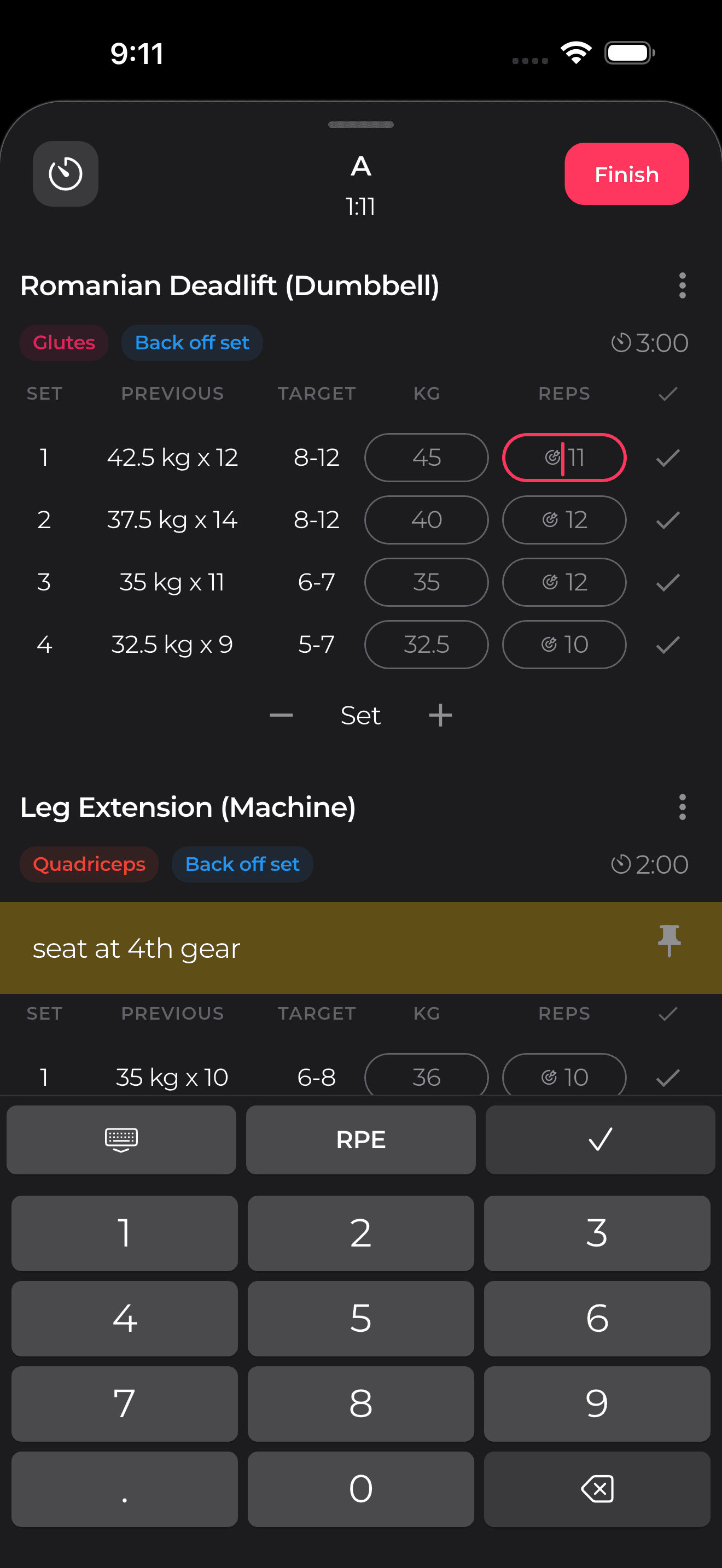
Four weeks can still be too short when a lift appears only once per week: four exposures may include a learning session and one bad day. Preserve load, reps, effort, and relevant notes with the workout-logging framework so the review is based on comparable sessions rather than memory.
Use Six Weeks as a Balanced Default
Six weeks is a useful default because it gives a twice-weekly lift roughly a dozen exposures and a once-weekly lift six. That is usually enough to separate a pattern from one strange session while keeping the next formal review close. This is a practical inference from training frequency, not a claim that adaptation expires after 42 days.
- Weeks 1–2: calibrate loads, exercise order, and realistic effort targets.
- Weeks 3–4: accumulate the planned work and progress the variables named by the program.
- Week 5: continue when the trend is productive or hold targets when fatigue is rising.
- Week 6: complete the planned loading week or use it as a reduced-stress transition, depending on the convention you wrote down.
For muscle-building blocks, decide the weekly dose with the training-volume guide rather than assuming a six-week calendar makes any set count recoverable. The mesocycle controls when you review volume; it does not determine the correct volume by itself.
Choose Eight Weeks Only When the Plan Is Stable
An eight-week structure can suit experienced lifters whose exercise selection, schedule, and loading rules are already dependable. Slower rep-range progression may need more exposures before several exercises reach their next load increase. A longer window can also keep the plan intact when the first weeks intentionally begin below maximum recoverable effort.
The extra time is valuable only when it buys useful repetition. It is not a reason to tolerate worsening technique, persistent discomfort, missed sessions that destroy the intended frequency, or targets that were clearly misloaded. Place intermediate reviews inside the block so week eight never becomes permission to ignore week-five evidence.
- Use stable exercises that can be compared across the full block.
- Schedule formal audits after weeks 3 and 5, not just at the end.
- Keep at least one progression variable explicit for each main exercise.
- Plan around holidays, meets, travel, and other dates that would split the final weeks.
- End early when the program's assumptions no longer match the training you can perform.
If exercise selection becomes the weak link, use the separate guide to decide when to change exercises. Changing one movement while preserving its program role does not automatically require abandoning the entire mesocycle.
Calendar Length Does Not Determine Readiness to Deload
Deloading research is still limited. An international Delphi consensus study used expert coaches to develop practical principles and defined deloading around reduced training stress, fatigue mitigation, recovery, and preparedness. Expert consensus can guide practice, but it is not an outcome trial proving that a deload must occur every fixed number of weeks.
The first direct randomized study of a mid-program break compared continuous training with one week of complete resistance-training cessation during a nine-week program. The break did not improve measured hypertrophy, power, or endurance and appeared to disadvantage lower-body strength. Complete cessation is not the same as every reduced-volume deload, and one study cannot settle timing, but it argues against treating a scheduled week off as automatically beneficial.
Accumulated fatigue also depends on how you train. In a small study of resistance-trained men, sets taken to failure delayed recovery compared with non-failure configurations. That finding concerns recovery from specific sessions, not mesocycle length, but it explains why two lifters can reach week six with very different readiness.
Use the dedicated deload week guide for ways to reduce training stress. Here, the key distinction is simpler: reaching the planned endpoint prompts a review; evidence of accumulated, widespread fatigue supports a deload decision.
Use a Multi-Signal Stop Rule
Do not end a block because one set felt bad, and do not continue because one isolation lift improved. Review several comparable exposures and look for agreement across performance, effort, technique, recovery, and program completion. The table below is an editorial decision tool, not a diagnostic test.
| Signal | Continue or extend | Review or end |
|---|---|---|
| Performance | Reps, load, or execution are improving on key lifts | Several key lifts regress across comparable exposures |
| Effort | Targets repeat at similar or lower RIR/RPE cost | The same work repeatedly requires much higher effort |
| Technique | Execution is stable or becoming more repeatable | Breakdown persists despite sensible load correction |
| Recovery | Soreness and readiness resolve before the next exposure | Fatigue or soreness repeatedly disrupts later sessions |
| Compliance | The actual week resembles the planned week | Schedule changes make the block's dose or frequency fictional |
One red flag may call for a local correction: reduce an obviously wrong load, fix rest periods, or substitute an aggravating exercise. Multiple red flags moving together make a block-level change more reasonable. A practical end-of-block review asks whether the same goal, exercises, weekly dose, and progression rules still deserve another week.
When missed targets are the main signal, follow the immediate options in what to do when you miss reps. When the question is whether the pattern is real, use the strength plateau or bad week review. Neither one disappointing workout nor a calendar notification establishes that a mesocycle is finished.
How to Extend a Productive Mesocycle
An extension should preserve the block's purpose. Add one or two weeks when key lifts are progressing, technique remains comparable, the work is recoverable, and the upcoming schedule can support the intended sessions. Write the new review date and avoid adding exercises or sets merely because the calendar gained space.
- Extend two weeks: the trend is clear and the existing progression still has room.
- Extend one week: a disrupted session made the final comparison inconclusive.
- Hold the endpoint: progress is slowing while effort and recovery cost are climbing together.
- End early: pain, a major schedule change, or repeated widespread regression makes the original plan unsuitable.
Do not use an extension to chase a round number or force every exercise to peak simultaneously. Different lifts move at different rates. The block succeeds when its main objective produced useful adaptation and a clearer next decision, not when every line in the log ends with a personal record.
Three Worked Examples
| Situation | Starting length | Review result | Next decision |
|---|---|---|---|
| Returning lifter with several new movements | 4 weeks | Technique improves, targets rise, recovery is stable | Extend two weeks without changing the exercise menu |
| Intermediate hypertrophy block | 6 weeks including transition | Most lifts rise, but week 5 shows higher effort and broader soreness | Keep the planned reduced-stress week, then redesign volume |
| Stable strength block before travel | 8 weeks | Progress continues, but travel starts after week 7 | Finish after week 7 instead of forcing an incomplete final week |
Notice that the four-week block became longer, the six-week block kept its planned endpoint, and the eight-week block became shorter. The original length created a review structure. The training record and real calendar determined the final length.
A Simple Way to Choose Your First Block
- Choose four weeks if exercise selection, recovery capacity, or attendance is uncertain.
- Choose six weeks if you have a repeatable schedule and want a sensible default review window.
- Choose eight weeks if the program is proven, progression is gradual, and intermediate audits are scheduled.
- State whether the final week is a loading week, deload, or separate transition.
- Record the minimum performance, effort, technique, recovery, and compliance inputs needed for review.
- At every checkpoint, continue, correct one local problem, extend, or end—do not default to the original date blindly.
If the objective is muscle gain, the broader hypertrophy training guide can help you define the exercises, effort, frequency, and progression that fill the weeks. This page owns the duration decision: how many weeks to plan and what evidence should change that plan.
Limitations and Safety
The research base does not directly compare complete four-, six-, and eight-week mesocycles across lifters, goals, and training ages. Periodization studies often use small samples, different exercises, different training histories, and fixed intervention lengths. Deload research is especially limited. The templates in this article therefore organize decisions; they do not predict an individual's optimal adaptation schedule.
Normal day-to-day variation should not be medicalized. However, persistent or worsening pain, sudden unexplained performance loss, fainting, chest symptoms, or other concerning changes are not problems to solve by extending a mesocycle or changing a spreadsheet. Stop the relevant activity and seek guidance from a qualified clinician. A coach can help with programming decisions, but should not diagnose a medical condition outside their scope.