A Miss Is a Signal, Not Its Own Prescription
Missing a rep means the planned repetition was not completed to the standard that makes it count. That could be a bar that does not move, a rep stopped for safety, a shortened range of motion, or execution that departs far enough from the intended technique that recording it as a clean success would be misleading. It does not automatically mean you have become weaker, reached a plateau, or need a deload.
This guide owns the immediate decision: what to do during the current session and at the next exposure. For the broader training principle, use the progressive overload guide. For a persistent performance pattern, use the plateau-or-bad-week review. Those are different questions from handling one missed target well.
First, End the Set Without Turning One Miss Into Three
Use the rack safeties, spotter, or normal exit for the lift. Do not immediately attempt the same failed rep again because frustration says you should prove it was a mistake. A missed repetition already gave you information; an improvised second maximum attempt can add fatigue without answering why the target was missed. The correct exit depends on the exercise and equipment, so set up safeties and a spotter before a difficult barbell set rather than solving the problem underneath the load.
- Record the repetitions actually completed, not the target you intended to complete.
- Note whether the limiting event was force, technique, range of motion, grip, equipment, or a deliberate safety stop.
- Check the plates, machine pin, exercise variation, and whether today's target was copied correctly.
- Record rest time when it was materially shorter than planned.
- Write one useful context note, such as a changed bench height or rushed warm-up, rather than a story about motivation.
The distinction between a force failure and a technical failure matters. Review the relevant bench press guide, squat guide, or deadlift guide when the miss exposes an exercise-specific setup or execution problem. This article cannot diagnose technique from a number in a logbook.
Classify the Miss Before Choosing the Response
| What happened | Clue | Current-session response | Next-exposure default |
|---|---|---|---|
| Technique failure | Range, position, or control changed before muscular failure | Stop the set; reduce load or use a controlled variation only if the movement remains appropriate | Fix setup or technique before progressing; get qualified coaching when needed |
| Load-selection error | Wrong plates, new machine, stale max, or target far above recent work | Correct the error and use a load that restores the intended rep and effort range | Update the working load; do not treat bad input as a meaningful stall |
| Isolated bad set | Previous work was on target and an obvious temporary factor changed | Take the planned full rest, then continue only if execution is stable | Apply the program rule; without one, repeating once is a reasonable editorial default |
| Repeated miss | The same target or lift has failed across exposures | Avoid extra grinders added outside the plan | Use the program's reset, set-scheme, load, or training-max rule |
| Accumulated fatigue | Several lifts, warm-ups, or sessions deteriorate together | Reduce optional fatigue and finish only useful work | Review block stress and recovery; a deload may be appropriate |
Choose the Rest of Today's Work Deliberately
The next set should preserve the session's purpose. If the program prescribes repeated heavy sets and the first miss came after abbreviated rest, take the full planned rest and reassess. If the first work set was nowhere near the target, repeating the same load for several more failed sets usually gives less useful practice than an appropriate back-off. If the movement itself is the problem, changing exercises can be more sensible than repeatedly reducing a painful or technically unstable pattern.
| Action | Use it when | Do not use it to |
|---|---|---|
| Repeat after full rest | The miss may reflect rushed rest, distraction, or a correctable setup error | Turn every failed rep into another maximum attempt |
| Reduce the load | The selected load cannot produce the intended reps and execution today | Hide a technique problem that remains at lighter loads |
| Change the set scheme | The written program calls for it, or a coach deliberately preserves volume with fewer reps per set | Invent a new program mid-session because the prescribed work felt hard |
| Substitute the exercise | Equipment is unavailable or the movement cannot be performed appropriately today | Avoid every lift as soon as progression becomes difficult |
| End the exercise | Safe execution cannot be restored or more sets would only repeat the same breakdown | Punish yourself by adding unrelated work |
A substitution should keep the job of the exercise as intact as possible. The exercise-change decision guide separates a temporary substitution from a permanent replacement, so one awkward session does not erase useful movement history.
At the Next Exposure, the Program Rule Comes First
There is no universal failure protocol because programs use missed reps differently. Some repeat the load, some change repetitions per set, and some use rep quality to decide whether a training max can increase. Applying a generic ten-percent reduction to all three would change the program rather than follow it.
For example, the official StrongLifts failure guidance says to repeat a failed 5x5 load at the next workout and, if the load has been repeated three times and still fails, reduce it by about ten percent. That prescribed repeat sequence belongs to StrongLifts 5x5; it is not evidence that every program should use the same number of attempts or a ten-percent reset.
The Cody Lefever and Boostcamp GZCLP prescription responds differently. A T1 failure changes 5x3 to 6x2 at the same load; later failures move to 10x1 before a new cycle. T2 work moves from 3x10 to 3x8 and then 3x6. Here, reducing reps per set is the intended progression path, not an improvised rescue.
Jim Wendler's published 5/3/1 beginner guidance emphasizes a correct, conservative training max and says not to increase it when reps become slow, grinding, or technically compromised. That makes rep quality part of the progression decision even before a literal failed lift. Follow the version of 5/3/1 you actually selected rather than combining rules from unrelated templates.
If Your Custom Plan Has No Failure Rule
A custom plan needs an explicit default before the next miss happens. The following is Olympian editorial guidance for generally healthy lifters, not a research-validated algorithm. It is deliberately conservative because one observation carries limited information.
Olympian editorial response tree
- 01Miss one target -> verify load, setup, rest, technique, and actual completed reps
- 02Clear input or setup error -> correct it and keep the intended progression unchanged
- 03Isolated miss with otherwise normal training -> repeat the target once at the next exposure
- 04Large miss or repeated miss -> reduce load, narrow the target, or revise the set structure
- 05Misses spreading across lifts and sessions -> review block fatigue and consider a deload
The word 'once' is an editorial review window, not a biological threshold. A coach may choose a different response based on the exercise, training age, goal, and cost of failure.
Define success in advance. A hypertrophy set might succeed when it lands inside an 8-12 rep range at the intended RIR with stable execution. A strength prescription might require every scheduled repetition. A technique-focused set may fail when position changes even if the rep reaches lockout. Without that definition, the same performance can be recorded as both success and failure depending on your mood.
If effort is part of the target, treat RIR as an estimate rather than a laboratory measurement. The full RIR progression guide explains how to calibrate it and why the same completed repetitions can lead to different next targets.
Three Worked Examples
Why More Failure Is Not Automatically More Useful
In a primary study of ten resistance-trained men, the protocol that took every bench-press and squat set to failure produced a larger acute performance decline and slower recovery over the following 24 to 48 hours than non-failure protocols. Read the study abstract and methods. The small male sample and specific protocols limit generalization, but the result is a good reason not to assume extra failed attempts are cost-free.
Effort estimates also contain error. In a study of 141 participants performing single sets to momentary failure, people generally predicted fewer remaining repetitions than they ultimately completed, though accuracy tended to improve with training experience. The PeerJ study does not make RIR useless; it shows why one estimated zero-RIR set should not be treated as perfectly precise evidence of readiness or fatigue.
The American College of Sports Medicine's progression position stand states that recommendations should be applied in context of goals, physical capacity, and training status. It supports progressive resistance training, but it does not validate this article's repeat-once tree or establish one universal percentage reduction after failure.
When a Deload Is More Plausible Than a Reset
A reset changes the loading path for a lift. A deload temporarily reduces training stress across part or all of the plan. One exercise failing at an ambitious target can justify a lift-specific repeat or reset while everything else continues normally. Several lifts regressing, warm-ups slowing, and previously manageable work becoming unusually costly make accumulated fatigue more plausible.
Do not recreate a full deload protocol from this section. Use the deload week guide for ways to reduce load, sets, repetitions, or effort. If the question is whether the current block has simply run long enough, review the mesocycle-length decision guide. Calendar week alone does not prove that a deload is due.
- Prefer a lift-specific response when one movement is failing and other work remains stable.
- Review a broader deload when performance loss spreads across several exercises or sessions.
- Fix obvious plan errors, such as unrealistic jumps or excessive added work, instead of repeatedly deloading around them.
- Use recovery context as supporting information, not as a diagnosis from one subjective score.
Log the Evidence You Will Need Next Time
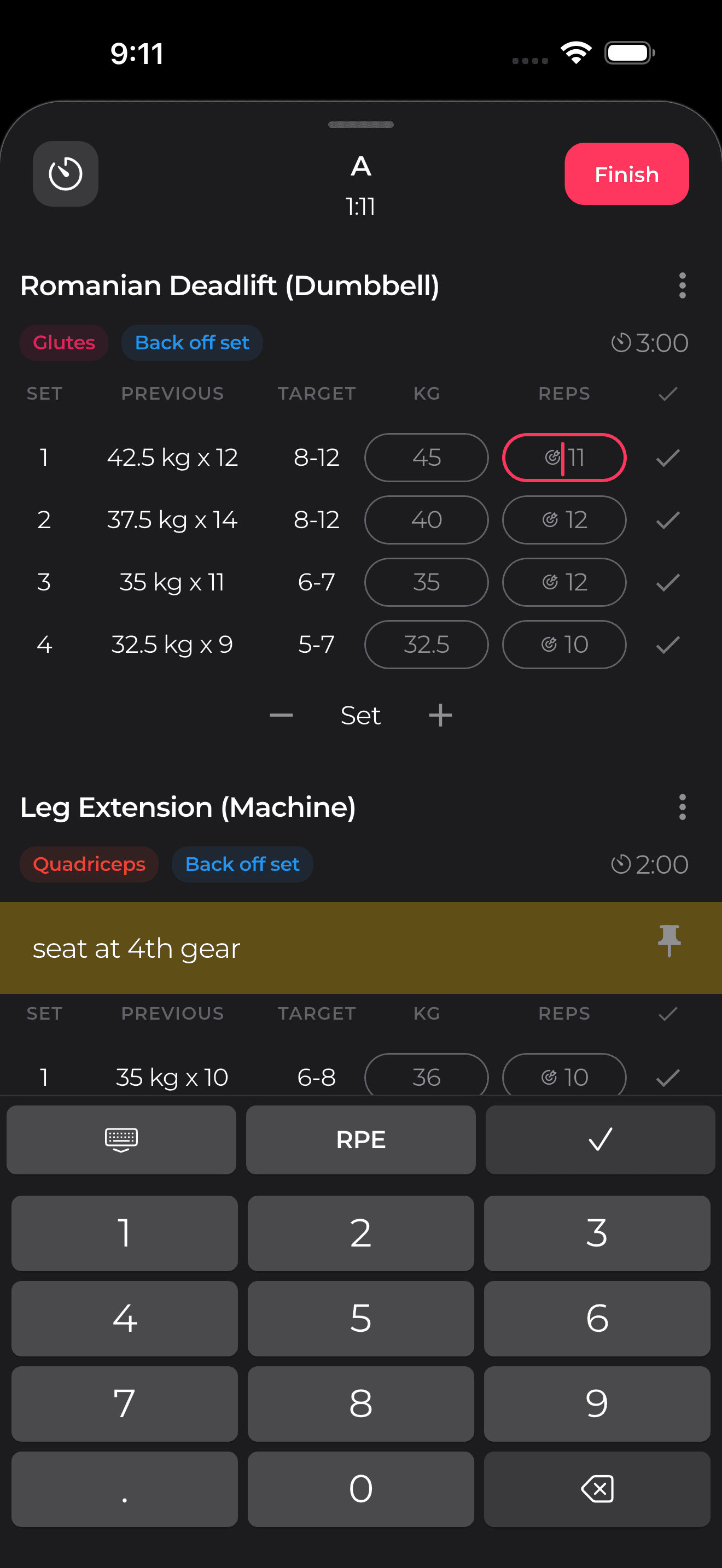
A useful missed-rep record includes the exercise and variation, planned and completed sets, exact load, rep-by-rep outcome when relevant, estimated effort, rest, and one short explanation of unusual context. The workout logging guide shows the minimum useful record without turning the session into data entry.
| Weak entry | Decision-ready entry |
|---|---|
| Bench was bad | Bench 100 kg: target 3x5, completed 5/5/4; final rep stalled near lockout; only 90 s rest before set three |
| Squat failed again | Squat 140 kg: target 5x3, completed 3/3/3/2; same load missed last exposure; warm-ups normal; follow program reset rule next |
| Too tired | Three main lifts below recent targets this week; effort higher at unchanged loads; optional volume added during prior two weeks |
The log should make the next decision auditable. If you reduce a load, write whether the action came from the named program, a coach, or your own default. If you substitute, preserve the reason and the original exercise. That prevents a temporary response from quietly becoming permanent programming drift.
Know When This Is Not Just a Programming Question
Stop the movement when it produces sudden pain, loss of normal control, dizziness, or another concerning symptom. This article cannot identify an injury, illness, or medical cause of unexplained performance loss. Persistent pain, recurrent symptoms, or a sudden decline without an obvious training explanation should be assessed by an appropriately qualified clinician. Technique problems may also require a qualified coach who can observe the lift rather than infer it from sets and repetitions.
For ordinary missed targets, the durable habit is simple: exit safely, record the truth, classify the likely cause, and apply the rule that belongs to your program. Repeat, reduce, change the scheme, substitute, and deload are all legitimate tools. None is the correct answer until the miss has enough context.