Change an Exercise Only When You Can Name the Job
The useful question is not “How many weeks have I done this exercise?” It is “What is this exercise supposed to accomplish, and is it still doing that job?” A competition squat may exist to build competition-squat skill. A leg press may exist to train the quadriceps with less balance demand. A row may exist to add back volume that does not interfere with the next deadlift day. Those jobs require different standards for continuity.
A systematic review of eight exercise-variation studies concluded that variation may influence regional hypertrophy and dynamic strength, but warned that excessive rotation and redundant exercises may hinder adaptations. That supports systematic variation based on anatomy, biomechanics, and goals—not a universal “muscle confusion” schedule. First define the exercise's role inside your progressive overload plan.
The Keep, Rotate, Substitute, or Replace Matrix
| Decision | Use it when | Preserve | Review point |
|---|---|---|---|
| Keep | Performance or execution is improving and the movement fits the goal | Exercise, setup, progression, and measurement continuity | Normal block review |
| Planned rotation | A block ends or another exercise offers a deliberate emphasis | Movement pattern, target tissue, or planned skill relationship | Next block boundary |
| Temporary substitution | Equipment, travel, scheduling, or a short-lived constraint removes the usual option | The session's intended movement and effort as closely as practical | As soon as the constraint changes |
| Permanent replacement | The movement repeatedly fails the goal, remains unacceptable, or is not sustainable | The program intent, not necessarily the exercise name | After a defined trial of the replacement |
These choices are not a hierarchy. Keeping is not automatically disciplined, and replacing is not automatically quitting. A lifter can stubbornly preserve a poor exercise match for months. Another can abandon a productive lift after one ordinary bad session. The right category depends on the evidence and the purpose of the movement.
When a single failed target triggers the question, separate the immediate set decision from the longer exercise-selection decision. Use the guide on what to do after missed reps before turning one miss into a permanent swap. If performance has been unclear across several exposures, use the strength plateau review to establish whether the problem is actually persistent.
Keep the Exercise When Continuity Is Producing Information
An exercise earns continuity when repeated practice produces clearer technique, comparable performance, and a progression you can interpret. You do not need a personal record every week. More reps at the same load and effort, the same reps with better control, or a stable target that now costs less effort can all justify keeping the movement.
- The movement directly tests a skill you care about, such as the competition squat, bench press, or deadlift.
- The target muscle is the practical limiter and execution stays repeatable across sets.
- Load, reps, range of motion, and effort can be compared without frequent setup changes.
- The exercise fits the available equipment and session time reliably.
- Its local and whole-session fatigue does not repeatedly degrade higher-priority work.
- You can perform it consistently enough for the progression rule to mean something.
Boredom alone does not prove an exercise stopped working. A flat week does not prove adaptation ended. Mild novelty elsewhere in the session may be enough to preserve adherence without discarding the main measurement anchor. Keep the high-skill priority lift and vary a lower-skill accessory, rep range, or secondary movement when that preserves both practice and interest.
Protect Skill-Specific Lifts From Casual Rotation
Strength is partly specific to the task used in training and testing. A 2025 meta-analysis found larger improvements in trained dynamic strength than transfer to non-trained isometric strength. A separate meta-analysis comparing machines and free weights reported that strength gains favored the mode used for the strength test, while neutral strength measures and hypertrophy were more similar. These findings do not make one tool universally superior; they show why the exact lift matters when the exact lift is the goal. A powerlifter should not remove the competition-style bench press merely because a machine press feels novel.
| Goal | Continuity priority | Variation can live here |
|---|---|---|
| Increase competition squat | Competition stance, depth standard, and bar position | Secondary squat, accessories, or volume-day variation |
| Build general quadriceps size | A repeatable knee-extension stimulus and useful range of motion | Squat, leg press, hack squat, split squat, or extension selection |
| Improve pull-up skill | The pull-up grip and movement pattern being tested | Rows, pulldowns, curls, and assistance volume |
| Train during travel | Broad movement and muscle-group intent | Equipment-specific replacement until normal access returns |
The more specific the performance goal, the more costly casual rotation becomes. Use the squat guide for the stable standards that make squat history comparable. This article does not prescribe technique or argue that a single variation is mandatory for everyone; it explains when continuity itself is part of the training effect.
Use Planned Rotation to Change Emphasis Without Losing Intent
Planned rotation changes an exercise for a stated reason at a stated review point. It may emphasize another region of a muscle, alter a resistance profile, redistribute training stress, or prepare the next phase. The replacement is selected before the first difficult workout of the new block, not improvised because motivation dipped halfway through a set.
Exercise selection can matter for where adaptation occurs. In a randomized study comparing Smith-machine squats with leg extensions, the groups showed different patterns of regional quadriceps growth. That narrow result does not prove that everyone needs both exercises or that rotation is superior to combination. It demonstrates that exercises are not always interchangeable simply because they share a muscle label. Match the new exercise to the emphasis of the next mesocycle.
- Write the current exercise's job: skill, target tissue, movement pattern, or fatigue-management role.
- Name the limitation the new exercise is intended to solve.
- Choose the closest useful match rather than the most different movement available.
- Set a new starting load and rep target; do not copy numbers between unlike exercises.
- Keep the replacement long enough to learn it and collect comparable exposures.
- Review whether it solved the stated problem before making the next rotation.
Temporary Substitutions Should Have an Exit Condition
A temporary substitution solves a constraint without silently rewriting the program. If the squat rack is occupied, a lifter might use a hack squat for the planned quadriceps work. If travel removes barbells, dumbbell or machine work may preserve the broad pattern. If the session is shortened, a stable machine may deliver useful work with less setup time. The substitute is not required to reproduce the old load or skill perfectly.
| Constraint | Substitution question | Exit condition |
|---|---|---|
| Equipment unavailable | What available movement best preserves today's intent? | Normal equipment returns |
| Travel or unfamiliar gym | Which exercise is safe and simple to set up here? | Return to the normal training environment |
| Temporary schedule pressure | What reduces setup while retaining useful work? | Normal session duration returns |
| Short-lived discomfort | Is there a tolerable alternative that does not reproduce the symptom? | Reassess before resuming; escalate if persistent or worsening |
Record that the movement was a substitution so its numbers are not mistaken for a continuation of the original progression. A ten-repetition leg press does not predict a ten-repetition back squat load. Preserve the target muscle, broad pattern, and intended effort where appropriate, then restart the original exercise conservatively if and when the constraint has resolved.
Discomfort Changes the Decision and Sometimes the Scope
Discomfort is not a character test and this article cannot determine its cause. Stop the set when pain is sharp, worsening, changes normal movement unexpectedly, or makes the exercise feel unsafe. Do not keep loading a painful movement for several weeks merely to prove that the exercise had enough continuity. A tolerable alternative may preserve training while the situation is assessed, but substitution is not treatment or a diagnosis.
If the issue is a nonmedical preference—an exercise feels awkward, the setup cannot be standardized, or the target muscle is never the practical limiter—test a plausible replacement with a lower starting load and clear execution standards. If the issue is pain, avoid promising that a grip, stance, machine, or mobility drill will fix it. The correct next step may sit outside programming.
Audit the Fatigue Cost Without Inventing a Scientific Ratio
| Audit item | Keep signal | Change signal |
|---|---|---|
| Target performance | The intended muscle or movement is challenged and progresses | Another limiter repeatedly ends the set first |
| Set-to-set quality | Execution remains useful across planned sets | Technique or output collapses before useful volume is completed |
| Session interference | Later priority work remains productive | This movement repeatedly degrades more important work |
| Between-session recovery | The next relevant session is not predictably compromised | Residual fatigue repeatedly disrupts the weekly plan |
| Setup and time | The movement is repeatable within available time | Setup complexity makes adherence or progression unreliable |
| Tolerability | Normal training effort without persistent concerning symptoms | Discomfort is persistent, worsening, or safety-relevant |
Research on acute fatigue shows that proximity to failure, set duration, total volume, and training density can materially affect fatigue responses. That does not mean the exercise name alone caused the problem. Before replacing a movement, check whether you changed the number of sets, rest, effort, or position in the session. Compare the full workload using the training volume guide rather than calling every tiring exercise inefficient.
Boredom and Adherence Are Real—But Need Proportionate Changes
In one eight-week randomized study of resistance-trained men, session-by-session exercise and rep-range randomization improved intrinsic motivation while producing broadly similar measured adaptations to a fixed routine. The study was small, included only trained men, and noted that some outcomes may have been attenuated by frequent rotation. It supports treating motivation as relevant, not treating random novelty as physiologically superior. A sustainable hypertrophy program can include variety without discarding every anchor exercise.
- Keep one or two priority movements stable while rotating accessories.
- Offer two preselected equivalents rather than choosing from the entire gym each session.
- Rotate at block boundaries so the history inside each block stays comparable.
- Change the rep range or equipment only when that still serves the exercise's job.
- If an exercise consistently makes you skip sessions, its theoretical advantages may not survive real adherence.
Preference deserves a place in exercise selection, especially when multiple options plausibly serve a general hypertrophy goal. It deserves less authority when a highly specific sport skill must be practiced. The solution is often a stable priority lift plus flexible assistance work, not all stability or all novelty.
Worked Decisions
Case one: a powerlifter's competition squat is progressing slowly but technique is stable, the lift is tolerable, and the meet is twelve weeks away. The squat stays because specificity is part of its job. If additional quadriceps work creates too much whole-session fatigue, the secondary squat can rotate to a more stable machine or single-leg movement. The priority skill remains visible while assistance absorbs the variation.
Case two: a hypertrophy-focused lifter uses a barbell row, but lower-back fatigue repeatedly limits the set and reduces the next lower-body session. A chest-supported row trains a similar broad pulling intent with different stabilization demands. Start a new progression rather than carrying the barbell-row load across. Review whether back training becomes more repeatable and whether the next lower-body session improves before declaring the replacement better.
Case three: a hotel gym has no squat rack for one week. A leg press and dumbbell split squat can preserve useful lower-body work, but they are temporary substitutions rather than proof that the normal squat should disappear. Mark the equipment constraint, use appropriate loads for the unfamiliar movements, and return to the normal plan conservatively when the constraint ends.
Case four: a curl variation has progressed but the lifter dreads it enough to skip arm work. Because the goal is general elbow-flexor hypertrophy rather than performance in that exact curl, a preselected cable or dumbbell alternative may improve adherence without sacrificing a required sport skill. Keep the replacement stable for a defined block so motivation does not become random exercise selection every session.
How to Preserve the Training Record After a Change
A swap creates a new measurement series. Record why it happened, what function should stay the same, the replacement's starting target, and when you will review it. Keep the old history; do not merge unlike loads or claim immediate progress because the new machine uses a larger number. The principles in the workout logging guide still apply, but the new exercise needs its own baseline.
- Reason: planned rotation, equipment constraint, adherence, fatigue cost, goal mismatch, or tolerability.
- Preserved intent: exact skill, movement pattern, target tissue, or session role.
- New baseline: exercise-specific load, reps, effort, setup, and range of motion.
- Exit or review condition: equipment returns, the next block begins, or a defined number of comparable exposures is complete.
- Outcome: whether the replacement solved the problem it was selected to solve.
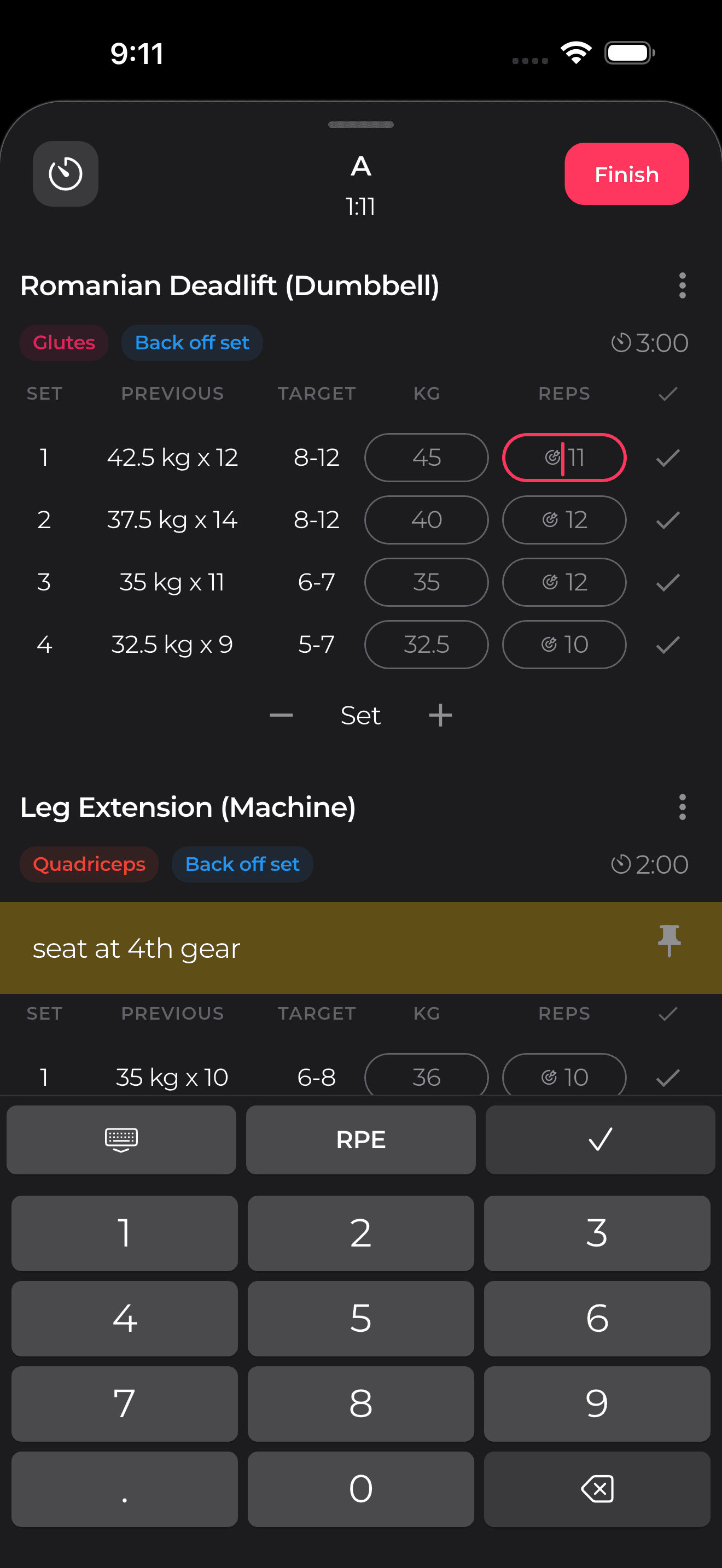
Olympian can keep exercise history, progression, volume, rotations, and block context together. Its role is not to prove that a substitute is medically safe or biomechanically perfect. The useful workflow outcome is traceability: the old movement remains in history, the new one starts with an honest baseline, and your review condition stays explicit instead of disappearing by the next workout.
Limits of Exercise-Change Rules
- Exercise-variation studies are few, often small, and use different schedules, exercises, participants, and outcome measures.
- Regional hypertrophy findings from one muscle or exercise pair cannot be generalized to every movement or body region.
- Short studies cannot show whether a rotation strategy remains effective or motivating over years.
- Task specificity means a replacement can build general capacity without fully preserving performance in the original exercise.
- The fatigue-to-stimulus audit organizes observations; it is not a validated numerical measure of adaptation.
- Discomfort cannot be diagnosed from a workout log, and persistent or concerning symptoms may require qualified assessment.
The durable rule is simple: do not change an exercise because novelty feels scientific, and do not keep it because consistency sounds virtuous. Define the job, identify the evidence, choose the smallest category of change, and preserve the part of the program that still matters. That produces variation with a reason—and continuity where continuity is itself the goal.