Use RIR as Context for Progression, Not as a Command
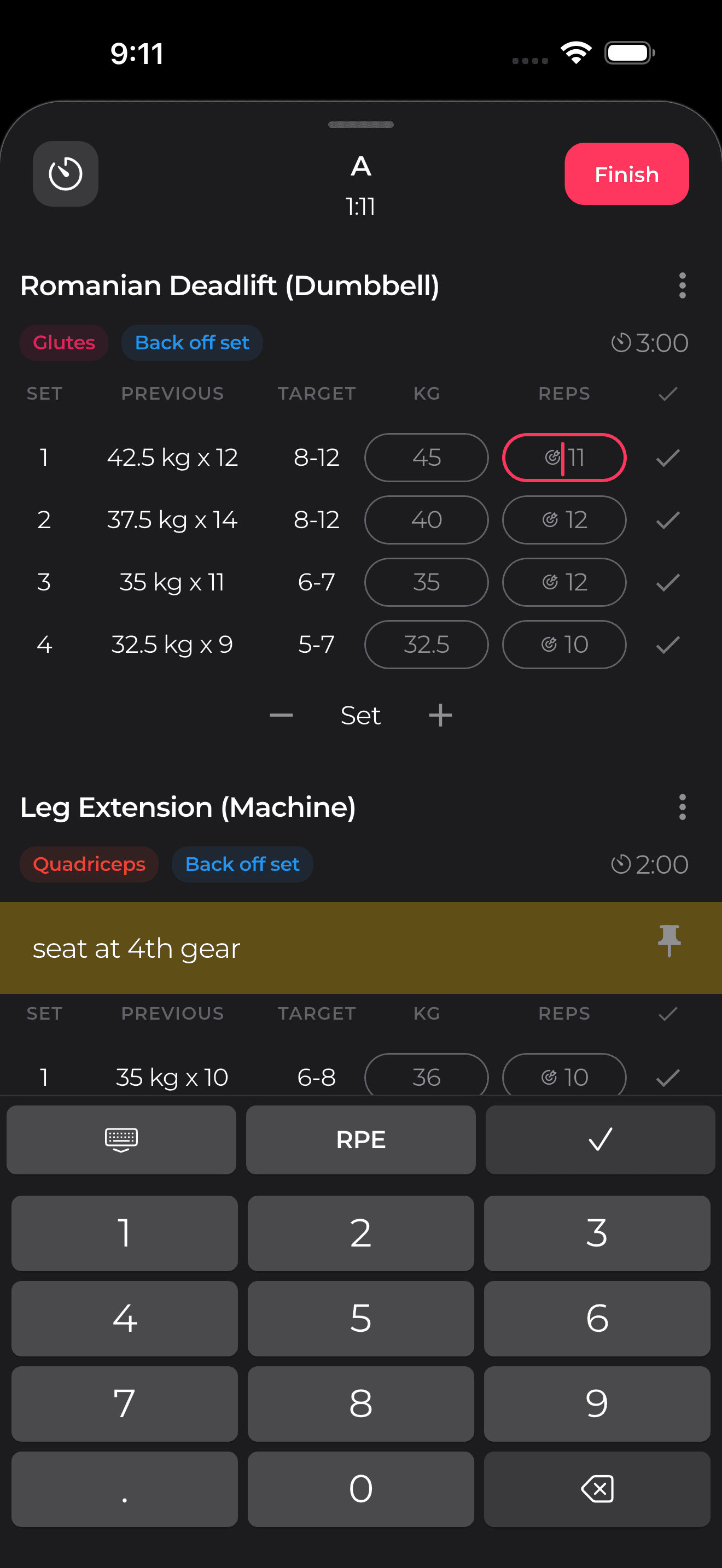
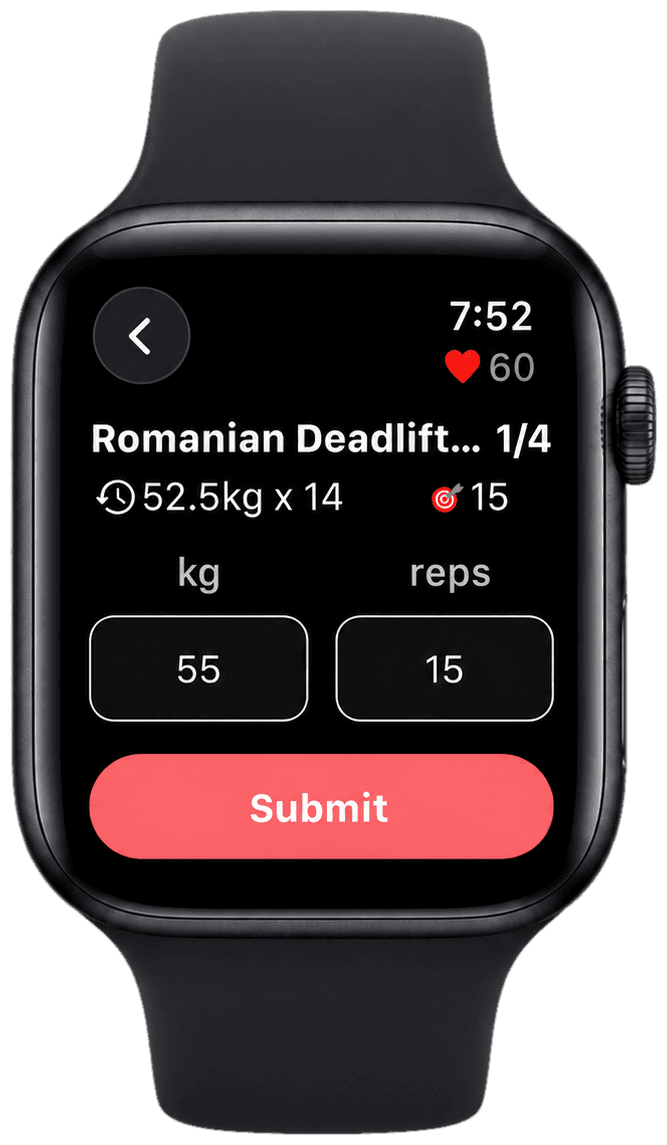
A log that says 80 kilograms for eight reps tells you what happened. Adding 3 RIR says the lifter believed about three acceptable reps remained. If the same load later produces nine reps at roughly 3 RIR, performance probably improved without requiring a harder effort. That is more decision-ready than reps or effort alone.
RIR is only one input. The progressive overload guide explains why a program may progress repetitions, load, sets, or execution. This guide explains how to use the effort estimate when deciding whether that planned progression happened.
What RIR Actually Measures
Repetitions in reserve is a prediction of repetitions remaining before a defined endpoint. For normal training, use technical failure as the practical boundary: the next repetition could not be completed with the exercise's agreed range of motion and execution standard. If you change the standard whenever a set becomes hard, the number stops being comparable.
| Reported RIR | Practical meaning | Common RPE mapping |
|---|---|---|
| 4 RIR | About four acceptable reps remained | RPE 6 |
| 3 RIR | About three acceptable reps remained | RPE 7 |
| 2 RIR | About two acceptable reps remained | RPE 8 |
| 1 RIR | About one acceptable rep remained | RPE 9 |
| 0 RIR | No additional acceptable rep remained | RPE 10 |
That RPE conversion is a common convention, not a precision instrument. Estimates farther from failure become broader because a lifter has less immediate evidence about the endpoint. It is often more honest to record a range such as 3–4 RIR in a note than to invent certainty between two plausible values.
RIR Is Useful Without Being Exact
The original resistance-training-specific RIR scale was tested across experienced and novice squatters. The 2016 study supported RIR-based RPE as a practical way to regulate daily load, but that does not make every estimate correct to one repetition.
A larger experiment involving 141 people found that participants underpredicted the repetitions they could perform to failure, with a tendency toward better accuracy among more experienced lifters. The study tested predictions before completing a set to failure, which is not identical to rating RIR immediately after every normal working set, but it clearly warns against false precision.
Think of RIR like a repeatable estimate on a familiar route. It can help distinguish comfortably submaximal work from near-limit work even when the exact distance to failure is uncertain. Its value rises when the same lifter applies the same standard to the same exercise and rep range over time.
Accuracy Changes with Load, Rep Range, and Proximity to Failure
In trained men performing bench press and prone row, estimates became more accurate as sets progressed closer to failure. Knowing the stated load or percentage of one-repetition maximum did not improve the estimate. Feeling the set unfold mattered more than being told the percentage.
Another study tested trained men across squat, bench press, overhead press, and prone row. Estimates of 2 RIR were most accurate with 85% of one-repetition maximum and became less accurate at 75% and 65% loads. At the lighter loads, lifters increasingly underestimated remaining repetitions by more than one rep, potentially stopping earlier than intended.
| Context | Confidence to place in exact RIR | Practical response |
|---|---|---|
| Heavy, familiar set near failure | Relatively higher | Use the number, while still allowing about one rep of error |
| Moderate-load set in a familiar rep range | Moderate | Compare the trend across repeated exposures |
| Light, high-repetition set | Lower | Use a wider RIR range and stable technique endpoint |
| New exercise or unfamiliar machine | Lower | Calibrate before using RIR to change load |
| Set stopped far from failure | Lower | Treat 5+ RIR as a broad effort category, not exact counting |
High repetitions add discomfort, pacing, and more possible repetitions to estimate. Exercise stability matters too: a machine curl, free-weight squat, and deadlift do not fail in the same way. Never transfer a calibration number from one exercise to another as though RIR were a universal sensor.
Reliability Is Not the Same as Accuracy
A study of 15 young novice-trained men reported high test-retest reliability when participants selected loads that produced 1 RIR for three-, five-, and eight-repetition bench press and deadlift sets. The loads selected were consistent between testing sessions, suggesting RIR can produce repeatable prescriptions even in a novice sample after familiarization.
That result does not conflict with studies showing estimation error. Reliability asks whether a process gives similar results when repeated. Accuracy asks whether an estimate matches the actual repetitions remaining. A lifter can consistently stop two reps earlier than intended: the method is repeatable, but the estimate is biased.
A Safe RIR Calibration Protocol
Calibration compares your predicted RIR with the repetitions actually available under the same technique standard. It does not require testing every exercise or taking every set to failure. Use occasional, planned checks on low-risk, familiar movements where equipment, safeties, or a competent spotter make the endpoint safe.
- Choose one familiar exercise and a load that normally permits about 6–12 repetitions.
- Define acceptable range of motion, tempo, and technical failure before starting.
- Perform the set and stop when you believe you have 2 RIR.
- Record that estimate before doing anything else.
- When safe, continue with the same execution until no additional acceptable rep is available.
- Count the completed extra reps and compare them with the estimate.
- Repeat the check on a later day under similar rest and setup conditions before changing your normal rating habit.
| Estimate | Extra reps completed | Calibration result | Meaning |
|---|---|---|---|
| 2 RIR | 2 | No observed error | The estimate matched this set |
| 2 RIR | 5 | Underestimated RIR by 3 | You stopped earlier than intended |
| 3 RIR | 1 | Overestimated RIR by 2 | You were closer to failure than believed |
One check does not establish a permanent correction factor. Sleep, rest intervals, exercise order, tempo, equipment, and motivation can change performance. Look for repeated bias. As an Olympian editorial rule, an error within about one repetition on a familiar moderate-to-heavy set is usually precise enough for ordinary programming; this is a practical tolerance, not a validated universal cutoff.
Beginners do not need frequent failure tests to earn the right to use RIR. Start with conservative loads, stable technique, and broad categories such as easy, moderate, and hard. Add the fields described in the workout-logging guide, then calibrate only when the movement is repeatable and the setup is safe.
Choose an RIR Target That Matches the Set's Job
There is no single RIR target for every lift. A technique set, heavy compound working set, and high-repetition isolation set have different purposes and costs. The program should name the target or range before the set so RIR does not become a story invented afterward.
| Set purpose | Illustrative starting range | Why |
|---|---|---|
| Technique or speed practice | 3+ RIR | Preserve execution and avoid turning practice into a grind |
| Repeatable compound working set | 2–4 RIR | Leave room to sustain technique and later sets |
| Hypertrophy-focused working set | 1–3 RIR | Create challenging work without requiring failure every set |
| Planned calibration to failure | 0 RIR endpoint | Use selectively when the movement and safety setup allow it |
| Program-defined AMRAP or plus set | Follow the written stop rule | Some end at technical failure; others deliberately stop with reps in reserve |
These ranges are examples, not outcome guarantees. Training age, exercise, weekly volume, set count, and the rest of the program matter. A target of 2 RIR on a 20-rep set may also be estimated less accurately than 2 RIR on a familiar six-rep set, so the same label does not create identical certainty or fatigue.
For muscle-building context, use the hypertrophy training guide to choose exercises, frequency, and effort, and the training-volume guide to evaluate the weekly dose. RIR describes proximity to failure on a set; it does not tell you how many sets the program needs.
Progress Only When Reps and RIR Agree
A useful progression rule names a rep target, an effort target, and the action taken when both are met. RIR alone cannot decide the action because adding repetitions and adding load are both viable forms of progression. In an eight-week trial involving resistance-trained adults, programs that progressed load and programs that progressed repetitions produced broadly similar adaptations, with small outcome-specific differences.
That load-versus-repetition progression study does not validate a particular RIR algorithm. It does show why an easier-feeling set need not trigger weight automatically: the program can deliberately progress repetitions first.
| Exposure | Performance | Interpretation | Next action |
|---|---|---|---|
| Week 1 | 80 kg × 8 @ 3 RIR | Baseline inside an 8–10 rep range | Keep load and add a rep if available at target effort |
| Week 2 | 80 kg × 9 @ 3 RIR | One more rep at similar estimated effort | Keep load and pursue the top of the range |
| Week 3 | 80 kg × 10 @ 2 RIR | Top of range at the intended 2–3 RIR | Apply the program's smallest planned load increase next time |
| Week 4 | 82.5 kg × 8 @ 2 RIR | Load increased while the set stayed in range | Build repetitions again |
How to Read the Same Load at Different Reps and RIR
| Earlier set | Later set | What changed |
|---|---|---|
| 100 kg × 8 @ 2 RIR | 100 kg × 9 @ 2 RIR | More reps at similar estimated effort: a clear positive signal |
| 100 kg × 8 @ 2 RIR | 100 kg × 8 @ 3 RIR | Same performance at lower estimated effort: likely improvement, within RIR error |
| 100 kg × 8 @ 2 RIR | 100 kg × 10 @ 0 RIR | More reps but much harder: performance rose, yet fatigue and program compliance changed |
| 100 kg × 8 @ 2 RIR | 100 kg × 7 @ 1 RIR | Fewer reps at higher effort: investigate context before changing the block |
The second row is why trend language matters. Moving from an estimated 2 RIR to 3 RIR may reflect real improvement, ordinary estimation error, or both. If it repeats while technique, rest, and setup remain comparable, confidence rises. One isolated rating should not overrule the rest of the record.
Also examine RIR drift across sets. Eight reps at 4, 2, and 0 RIR may mean the starting load was manageable but the rest interval or total set prescription made later work much harder. Averaging those values into 2 RIR would hide the session shape. Record each working set and compare like with like.
Do Not Turn One RIR Miss into an Automatic Adjustment
Suppose the target is eight reps at 2 RIR, but today's first set is eight reps at 0–1 RIR. Check whether the load, equipment, range of motion, rest, and warm-up match the previous exposure. If the set was technically acceptable and there is no safety concern, the immediate choice may be to reduce the next set, hold the load with fewer reps, or stop the progression attempt. The program and remaining workout determine which response fits.
Use the immediate decision tree in what to do when you miss reps when RIR and performance both miss the prescription. If several comparable exposures form a pattern, use the strength plateau or bad week review before declaring that progression has stalled.
A high RIR can also be misleading if treated automatically. Completing eight reps at 5 RIR in a strength program may mean the load is too light, or it may be an intentional technique week. Completing a warm-up at 8 RIR never commands a load jump outside the warm-up plan. Interpret effort inside the set's assigned job.
Not Every Productive Set Must Reach Failure
A systematic review and meta-analysis found no evidence that reaching momentary muscular failure was superior to non-failure training for hypertrophy, although the literature was limited and definitions of failure varied. Its results suggested a potentially non-linear relationship between proximity to failure and hypertrophy, rather than a rule that every step closer always creates more growth.
A later eight-week study in 18 resistance-trained participants found similar quadriceps hypertrophy when one leg trained to momentary failure and the other stopped at perceived 2 RIR and 1 RIR, while failure produced greater repetition and velocity loss. This small, exercise-specific study does not prove that every non-failure prescription is equivalent. It shows only that, under the studied conditions, productive quadriceps hypertrophy did not require every set to reach 0 RIR.
Use failure selectively when the program calls for it, the exercise is appropriate, and the safety setup is adequate. RIR is useful precisely because it lets a program distribute effort instead of turning every working set into the same endpoint.
Review RIR Across a Mesocycle
At the end of a training week, compare key exercises against their intended RIR ranges. Look for more reps at similar effort, the same reps at lower effort, successful load increases that stay inside the prescription, and widening set-to-set RIR drift. The trend should answer a program question, not merely produce an average score.
Use the guide to choose and end a mesocycle when effort trends join performance and recovery signals. Repeatedly rising RIR at the same performance may support progression; repeatedly falling RIR with stagnant or lower performance may support review. Neither pattern alone proves readiness for a deload.
If fatigue appears across several lifts and sessions, the deload guide explains how reducing sets, load, repetitions, or effort changes training stress. Do not schedule a deload because a single RIR estimate moved by one point.
Common RIR Mistakes
- Changing the definition of an acceptable repetition as the set becomes difficult.
- Treating 2 RIR as exact despite light loads, high reps, or an unfamiliar exercise.
- Using the first set's RIR to describe every set in the exercise.
- Adding load whenever RIR is higher than expected, regardless of the programmed rep target.
- Taking every set to failure in the name of calibration.
- Assuming an easier isolation exercise estimate transfers to a squat, bench press, or deadlift.
- Confusing normal uncertainty with dishonesty or lack of effort.
- Ignoring pain or major technique changes because the logged RIR seems acceptable.
Limitations and Safety
Most RIR accuracy studies use modest samples and controlled sets involving selected exercises and loads. Findings from young men, trained lifters, novice samples, or single exercises should not be assumed to apply identically to every lifter. Study definitions of failure, prediction timing, equipment, and repetition range also differ. RIR should therefore be treated as exercise- and context-specific.
Calibration sets to failure add fatigue and can add risk. Use safeties, appropriate equipment, and a competent spotter where relevant; avoid failure tests when technique is unstable or the exercise has a poor failure path. Persistent or worsening pain, sudden unexplained performance loss, fainting, chest symptoms, or other concerning changes require guidance from a qualified clinician rather than an RIR adjustment.